

I recently came across the following image.
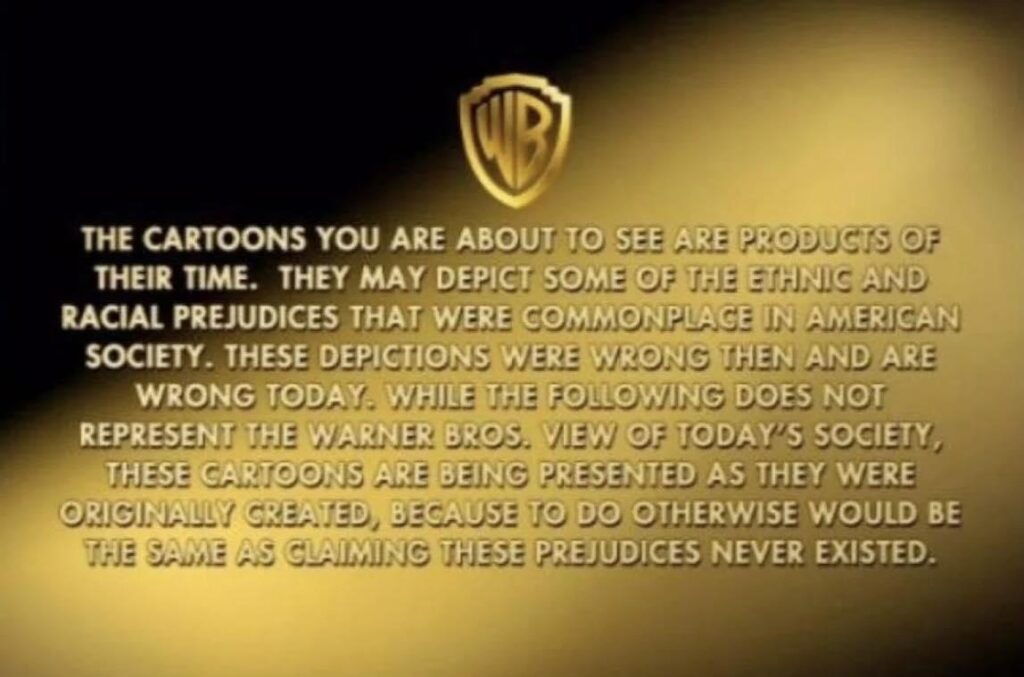
The disclaimer explains that the cartoons are products of their time and may include ethnic and racial prejudices that were once commonplace in American society. It acknowledges that these depictions were wrong in the past and remain wrong today. Yet, importantly, Warner Bros. chooses to present these cartoons in their original form, accompanied by this contextual note.
Several aspects of this disclaimer merit closer examination.
First, it provides a clear and unambiguous acknowledgment of the prejudiced content present in the original works. This is an honest reflection of a historical reality, not an attempt to dilute or excuse it. By stating that such prejudices existed, Warner Bros. encourages viewers to understand the social and cultural environment in which these works were created.
Second, the disclaimer affirms that the prejudices depicted were unacceptable at the time of their creation as well as in the present. This is an important ethical stance. It avoids the common argument that discriminatory portrayals were somehow morally acceptable simply because they were widely tolerated. Instead, it makes the point that harmful depictions were wrong then and continue to be wrong now.
Third, the decision to present these cartoons without censorship is itself significant. Warner Bros. explains that altering or removing the original content would be equivalent to pretending that these prejudices never existed. This approach allows audiences to confront historical issues directly. It creates an opportunity for learning rather than avoidance.
The relevance of this approach becomes especially clear when considered alongside recent debates surrounding the revision of Roald Dahl’s works. There has been widespread controversy about attempts to modify Dahl’s books in order to align them with contemporary sensibilities. More information on this matter can be found here: https://en.wikipedia.org/wiki/Roald_Dahl_revision_controversy
I respectfully disagree with the move to censor or modify any artist’s original work. Linguistic and cultural norms do change over time. Words such as “retarded” were once considered clinical descriptors, and the word “gay” once meant “happy” without any additional connotations. These shifts illustrate how evolving social attitudes reshape the meaning and use of language.
However, changes in cultural norms do not justify altering historical works to conform to present-day expectations. Such revisions risk eroding the integrity of the original material. They also make it more difficult for future generations to understand how society once operated and what beliefs were considered mainstream. To censor a past work is, in a sense, to erase part of the historical record.
Preserving original works while providing appropriate context represents a balanced and responsible approach. It allows the audience to engage with the material critically and thoughtfully. It also ensures that the artistic and cultural heritage of earlier eras remains intact, even when it reflects values that we now reject.
For these reasons, I commend Warner Bros. for choosing transparency and preservation rather than alteration. Presenting historical works with contextual explanations promotes understanding, reflection, and accountability. It acknowledges past wrongs without obscuring them, and it respects the integrity of the artists’ original creations.
In a world where attitudes and language continue to evolve, it is essential to preserve history without rewriting it. Only by confronting the past as it truly was can we fully appreciate how far society has progressed and how much further it still needs to go.